Heraldry and Corps Badges Guideline
REFERENCES
- Badges of the Canadian Forces (CFP 267)
- Badges of the Royal Canadian Navy
- Canadian Heraldic Authority
- The Royal Heraldry Society of Canada
PURPOSE
This guide provides direction for the design and approval of Cadet Corps badges. Badges are official symbols that reflect the history, identity, and values of the Cadet Program. They must uphold heraldic tradition while projecting a positive image of youth, leadership, and service.GENERAL PRINCIPLES
- Reflection of the Cadet Program: The badge shall represent the Corps as part of the broader Cadet Program and must maintain a dignified, professional appearance.
- Heraldic Integrity: Designs shall follow heraldic rules, ensuring clarity, balance, and proper symbolism.
- Simplicity and Distinction: The badge shall be distinct, easily recognizable, and avoid unnecessary complexity.
- Cultural and Historical Sensitivity: Elements must respect Canadian heritage, the Cadet Program’s traditions, and local community significance.
HISTORICAL BACKGROUND OF THE SHIPS’ BADGES
Originally, naval ships were identified by figureheads that symbolized their spirit, personality, or name. With the transition from wooden sailing ships to steam-powered iron and steel vessels, figureheads disappeared, though some were preserved from older ships. Decorative gilded scrollwork with heraldic devices then adorned iron warships’ bows, evolving into the forerunner of modern ship badges.Over time, these devices were displayed on quarterdecks or gun tampions, but without standardization—designs often changed at the captain’s discretion. This informal system sufficed until World War I, when the rapid expansion of the Royal Navy created confusion in ship identification. In 1919, a formal system was established in collaboration with the College of Arms. They mandated that each ship’s badge be placed within a standard frame: a rope border topped with a naval crown and a nameplate beneath it. This design remains in use today.
Several shapes of this frame were used to distinguish different types of ship, namely:
- Circular - for capital ships;
- Pentagonal - for cruisers;
- Shield-shaped - for destroyers and submarines; and
- Lozenge-shaped - for carriers and auxiliary vessels.
EVOLUTION OF RCN SHIPS’ BADGES
The badge’s device represented the ship’s name, while the frame could change with the ship’s type or role. Between the wars, the small Royal Canadian Navy (RCN) followed the Royal Navy’s system, using shield-shaped badges with three green maple leaves for Canadian distinction.During World War II, the RCN’s rapid growth led to a flood of unofficial, often non-heraldic and cartoon-style badges designed by crews. After the war, an official heraldic system was established: a circular rope frame with naval crown and nameplate, with Canadian identity shown by three overlapped gold maple leaves at the base.
BADGE VS. COAT OF ARMS
A coat of arms, originating in the Middle Ages, served as personal identification and often reflected family ties. It is complex in design, legally belongs to one person or organization, and cannot be shared.A badge, by contrast, was created to identify a leader’s followers or a clan’s members, using a simplified element of a coat of arms within a frame. Ships’ badges follow this tradition - representing all members of a corps, unit or training establishment - and while based on heraldic rules, they differ from the stricter rules of coats of arms.
CADET CORPS BADGES
In 1984, Royal Canadian Sea Cadet Corps adopted badges identical in size and design to naval ship badges, but with three red overlapping maple leaves and gold nameplates with black lettering. In 1988, Navy League Cadet Corps introduced a distinct seven-sided badge with a naval crown and three maple leaves at the base.By 1995, a shield-shaped badge was created for Navy League Corps Squadrons.
Please refer to Annex A for the three design frames for Cadet Corps Badges.
THE FRAME OF THE BADGE
A badge’s frame has four fixed elements:- Naval Crown – A gold circlet with alternating ship sterns and square sails (sails always white, rest in gold).
- Name Plate – Displays only the ship or corps name. Canadian Navy ships may use contrasting colours, but all RCSCC and NLCC badges use gold plates with black (or occasionally white) lettering.
- Rope Border – Normally circular and gold. Exceptions exist for certain historic RN names, but any new corps must use the circular frame.
- Maple Leaves – Always red for Sea Cadets and Navy League Cadets (gold outline only for HMC ships). Cadets must use their approved badges only, and may not wear official ship badges or other unapproved designs.
DESCRIPTION OF BADGE
- Description: Means the heraldic language used to define the devices and colours of a badge;
- Emblazonment: Means a painting or other full colour representation of a badge;
- Motto: Means a word, phrase or short sentence expressing an appropriate reflection, sentiment or rule of conduct, usually in Latin although English, French or other language is acceptable.
SELECTION OF A DESIGN
A corps badge must symbolize the name itself, not the ship type or location (unless the name and location are the same). Several methods can be used to represent the name heraldically:- Namesake Ship – Adopt or adapt the badge of the original RN/RCN ship, if one exists.
- Direct Depiction – Use a recognizable animal or object directly from the name (e.g., husky, raccoon), often in heraldic form.
- Rebus (Visual Pun) – Represent the name through symbolic wordplay (e.g., “Gran-Bee” for GRANBY).
- Personal Attribute – Use an object linked to the occupation or qualities of a namesake person (e.g., Champlain’s astrolabe).
- Personal Arms – Incorporate an element from the heraldic arms of the namesake.
- Community Origin – Draw from the historical or linguistic origin of a place name.
ASPECTS TO AVOID IN BADGE DESIGN
When designing a corps badge, several pitfalls must be avoided:- Pictorial Scenes – No realistic landscapes or photographic-style images; heraldry is symbolic, not pictorial.
- Compartments – Do not divide the badge into sections (as in coats of arms).
- Clutter – Use a single clear device rather than multiple competing symbols.
- Visual Clichés – Avoid overused symbols like anchors, maple leaves, or fleurs-de-lis, since naval/Canadian identity is already shown by the crown and leaves.
- Modern Objects – Exclude modern ships, equipment, buildings, or real people; heraldry favors timeless, traditional symbols (mythological figures are acceptable).
PROHIBITED ELEMENTS
- Corporate logos or commercial symbols.
- Symbols of political, religious, or partisan affiliation.
- Overly complex or cartoon-style imagery.
- Inappropriate or negative symbolism.
HERALDIC RULES
Corps badges follow core heraldic principles:- Direction – Figures usually face forward or to the heraldic left (dexter). Facing right (sinister) is rare.
- Geometric Designs – Shapes like bends (diagonal bands) and piles (triangles) are common but must follow heraldic standards; misuse (e.g., wavy bends without relevance) is discouraged.
- Colours (Tinctures) – Use bold primary colours (red, blue, green, black, gold, silver). Pastels are avoided. The key rule: colour on metal or metal on colour, to ensure contrast. Exceptions exist (e.g., naturalistic depictions, borders, or multi-part fields). Never use two shades of the same colour in one badge.
- Lines of Partition – Dividing lines (wavy, indented, scalloped, etc.) follow heraldic conventions. Wavy lines are most common in naval badges to symbolize water.
- Barry Wavy – Alternating blue and white bars represent the sea. They must be equal in number and width, with white (or gold) at the top and blue at the bottom.
DESIGN PRINCIPLES
- Detail – Keep designs simple; badges must be reproducible within a 38 mm (1.5 inch) circle.
- Simplicity – Avoid overcrowding with multiple symbols; one clear device is best.
- Restrictions – Corps numbers, mottos, locations, or words like Sea Cadets / Navy League Cadets must not appear in badge designs.
Corps or Branches seeking help with badge design can request guidance and design concepts by writing to the National Office:
c/o The Navy League of Canada
National Office
221-815 St. Laurent Blvd
Ottawa, ON K1K 3A7
heraldry@navyleague.ca
Annex A – Cadet Corps Design Frame
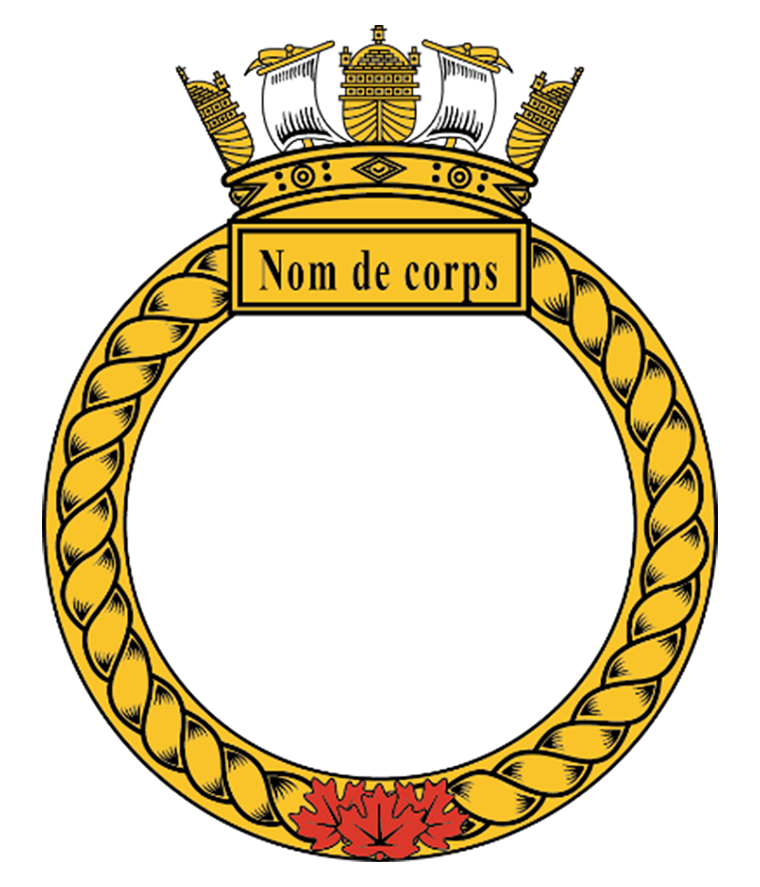
Sea Cadet Corps Design Frame
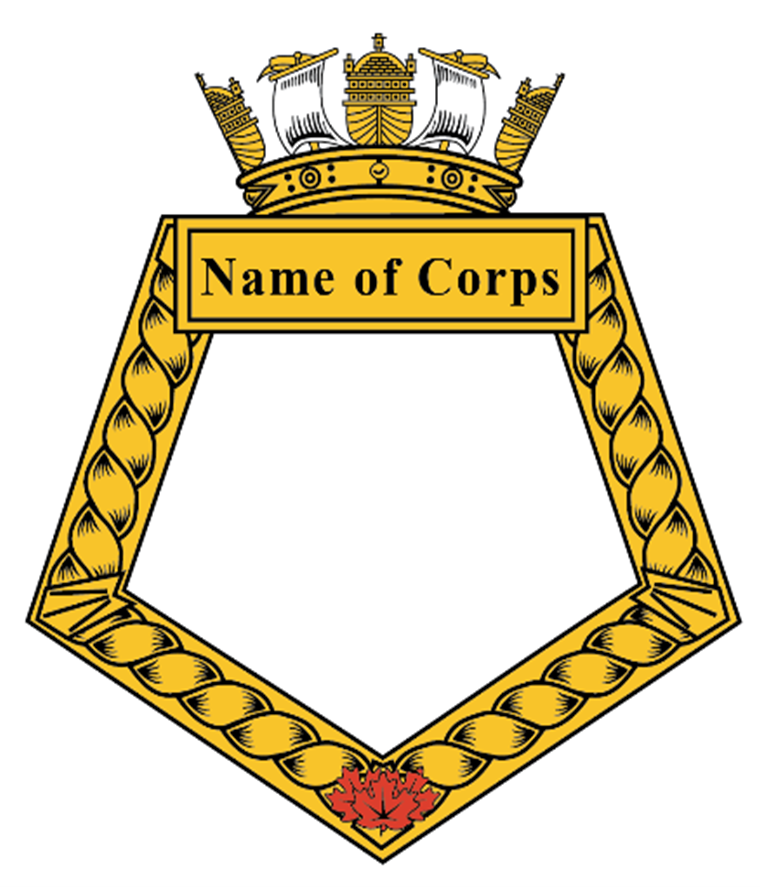
Sea Cadet Corps Design Frame
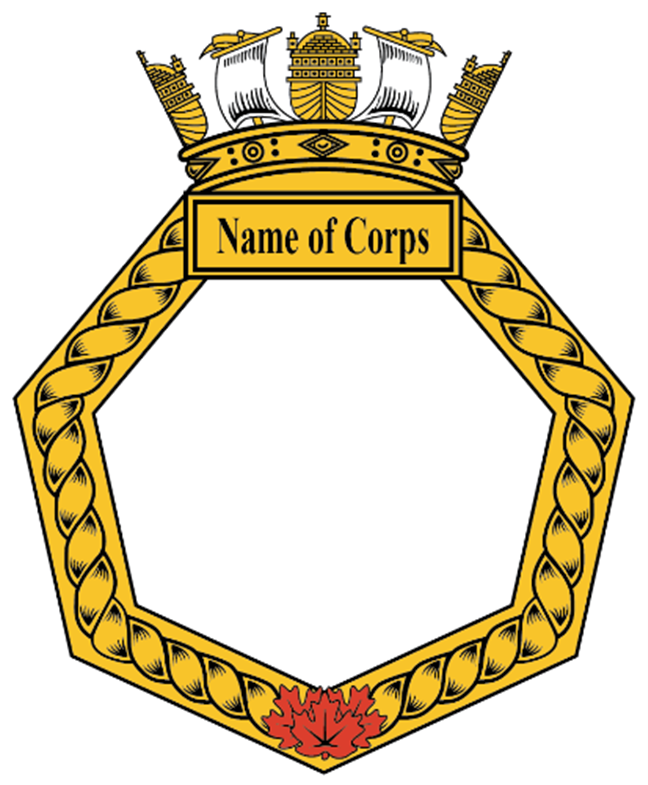
NL Cadet Corps Design Frame
Annex B – Approved Design Frame Template Certificate
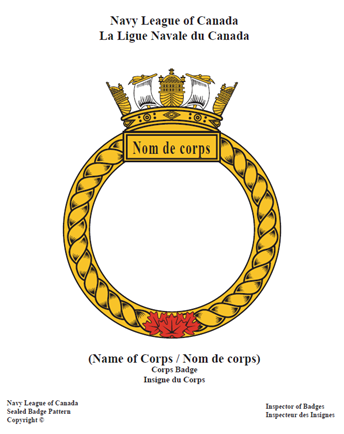
Sea Cadet Corps Frame Approved Certificate
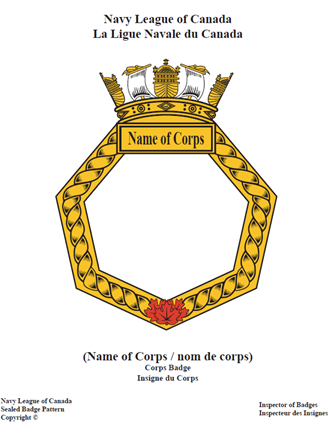
NL Cadet Corps Frame Approved Certificate